
Solutions for application owners.
Some of the business-critical problems that meshIQ is solving for businesses around the world.




Boost productivity and overall efficiency.
Middleware is essential for building scalable, on-premises, hybrid and multi-cloud applications. Manage and automate your middleware-powered deployments through your entire business, boost productivity and overall efficiency of your administrators, engineering, and operations teams to ensure smooth, uninterrupted delivery of mission-critical digital services.
Immediate ROI.
Locate, track, identify, and correct delayed and lost file transfers
Problem.
- Migration from IBM MQ on the mainframe; data center migration
- Unacceptable MTTR (mean time to repair) and overall problem resolution efficiency and speed with included IBM MQ tools and homegrown tools
- Must not have uncertainty regarding the customer experience (CX) for the new customer acquisition system. “Speed to market” is a new competitive priority
Solution.
Mean Time To Repair (MTTR) and overall problem resolution speed and efficiency has never been more important. The company had the tools that came with IBM MQ (as well as some tools that were homegrown to augment them) but as workloads and the environment grew, so did the expectations for CX and any problems impacting it.
Accelerate DevOps initiatives, cloud migrations, EMR rollouts.
Deep, real-time file monitoring.
ACH (Automated Clearing House) is a US financial network developed to allow institutions (banks and others) to transact electronic payments and money transfers, without having to rely on paper checks, credit cards, wire transfers or cash.
To ensure that we can have confidence in the process of making and receiving ACH payments, requires that regulations are followed.
What meshIQ can do to help you manage your ACH transactions and comply with both internal governance and regulatory compliance requirements.
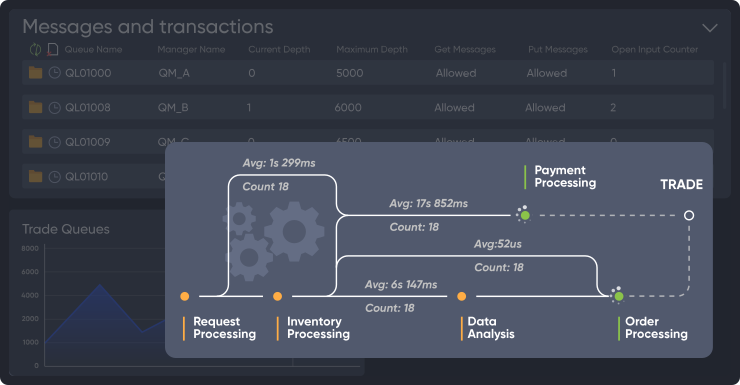
meshIQ can monitor all the systems associated with ACH transactions and by reading the payloads of each ACH transaction message can present a complete view of the pathway of each ACH transaction, overlaying the performance data from each system associated with the transaction to provide a visual method of analyzing each transaction and allowing for both real-time and historical reports to be generated to meet internal governance and regulatory compliance needs and to provide predictive and proactive report of any likely issues.
Accelerate compliance.
What meshIQ can do to help you manage your Dodd-Frank Compliance.
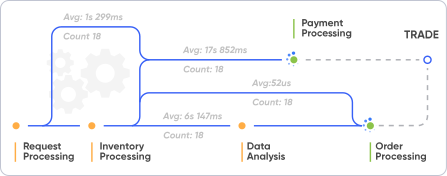
meshIQ can monitor all the systems associated with Dodd-Frank transactions and by reading the payloads of each Dodd-Frank transaction message can present a complete view of the pathway of each Dodd-Frank transaction, overlaying the performance data from each system associated with the transaction to provide a visual method of analyzing each transaction and allowing for both real-time and historical reports to be generated to meet internal governance and regulatory compliance needs and to provide predictive and proactive report of any likely issues.
The Dodd-Frank Act includes requirements that all financial trades be reported to the US government. There are a number of different government departments that now provide oversight on trades.
These include:
- The Financial Stability Oversight Council, who monitor major financial firms’ liquidity
- The Consumer Financial Protection Bureau (CFPB) monitors mortgage lending
- The Federal Insurance Office, who monitor insurance companies
- And the number of additional federal, state and local government organizations that continually monitor transactions to ensure that they meet each legal requirement
- The Securities and Exchange Commission (SEC) ensures that companies that trade fairly represent their institutions and products
HIPAA-compliant log management.
What meshIQ can do to help you manage your MiFID II Compliance.
meshIQ can monitor all the systems associated with MiFID II transactions and by reading the payloads of each MiFID II transaction message can present a complete view of the pathway of each MiFID II transaction, overlaying the performance data from each system associated with the transaction to provide a visual method of analyzing each transaction and allowing for both real-time and historical reports to be generated to meet internal governance and regulatory compliance needs and to provide predictive and proactive report of any likely issues.