

This roundup is part of our Apache ActiveMQ® CVE guide, which lists every advisory with its scores and fixed versions. Here we step back: what happened, what was exploited, what the patterns say, and what to plan for in 2027.
2026 by the numbers
| Measure | 2026 |
| Apache ActiveMQ® CVEs with 2026 IDs | 25 |
| Apache ActiveMQ® CVEs published in 2026 (NVD), including CVE-2025-66168 | 26 |
| Apache severity of the 25 | 17 Important, 7 Moderate, 1 Low |
| Exploited in the wild (CISA KEV) | 1: CVE-2026-34197 |
| Apache ActiveMQ® releases | 26 (11 on 5.19.x, 10 on 6.2.x, 4 on 6.3.x, 1 on 6.4.x) |
| Release lines retired | 6.2.x, now end-of-life |
| New release lines | 6.3.x (July), 6.4.x (October) |
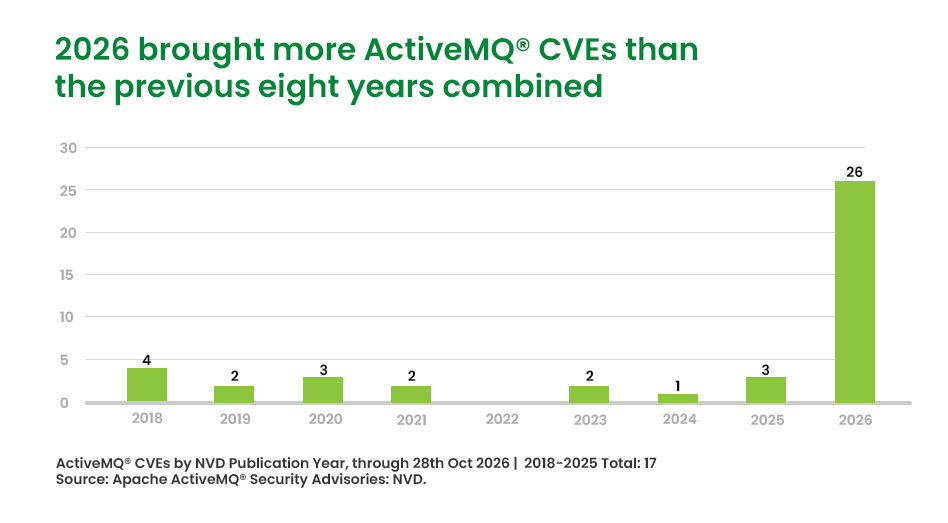
For context, Apache ActiveMQ® CVEs published from 2018 to 2025 add up to 17 in total. The volume jump is real, and it changed how often teams running Apache ActiveMQ® had to act.
How the year unfolded
Each Apache ActiveMQ® security advisory arrived in a batch, tied to a release:
| When (2026) | What happened |
| March | CVE-2025-66168 (MQTT) published; release cadence speeds up |
| 6–9 April | CVE-2026-34197 (Jolokia RCE) disclosed with three others |
| 16 April | CISA adds CVE-2026-34197 to the KEV catalog |
| 23 April | Three more CVEs, including the first bypass of the 34197 fix (5.19.6 / 6.2.5) |
| 31 May – 1 June | Hardening release 5.19.7 / 6.2.6 and six CVEs |
| 29–30 June | Largest batch of the year: nine CVEs, fixed in 5.19.8 / 6.2.7 |
| 27–28 July | 6.3.0 released (Java 17+); two CVEs |
| 2–9 September | 6.3.2 and 5.19.11; CVE-2026-74761, the last 2026 advisory so far |
| 26 September | 6.2.10, the last 6.2.x release; the line is now end-of-life |
| 27 October | 5.19.12, 6.3.3 and 6.4.0 released |
Apache shipped at least one Apache ActiveMQ® release every month from February to October. For teams used to patching Apache ActiveMQ® once a year, that is the real change.
What was actually exploited
CVE-2026-34197 is the 2026 CVE that attackers used. An authenticated user, or anyone on 6.0.0 to 6.1.1, where CVE-2024-32114 left Jolokia without a login, could make the broker load a remote Spring configuration and run code. Fortinet reported exploitation attempts within about a week of disclosure, and CISA added it to the KEV catalog on 16 April with a 30 April deadline for US federal agencies.
We covered the KEV listing, the exposure figures, and how to check for compromise in our CISA KEV alert on CVE-2026-34197. Read the full alert →
CVE-2023-46604 is still the bigger long-term threat. The 2023 OpenWire flaw has been used by ransomware, cryptominers, and botnets since disclosure, and in August 2025 the DripDropper campaign used it, then patched brokers behind itself to lock out rivals. We covered why a patched broker isn’t necessarily a clean one in Two Years Later: CVE-2023-46604 Is Still Felling Apache ActiveMQ® Brokers. Read the full breakdown →
None of the other 24 CVEs from 2026 have a public exploitation report or a KEV listing as of late October. That’s a reason to plan the patch, not to skip it: 34197 went from disclosure to exploitation in days.
Still catching up on 2026’s advisories?
Five patterns in the 2026 Apache ActiveMQ® security advisories
1. Jolokia was the route to code execution
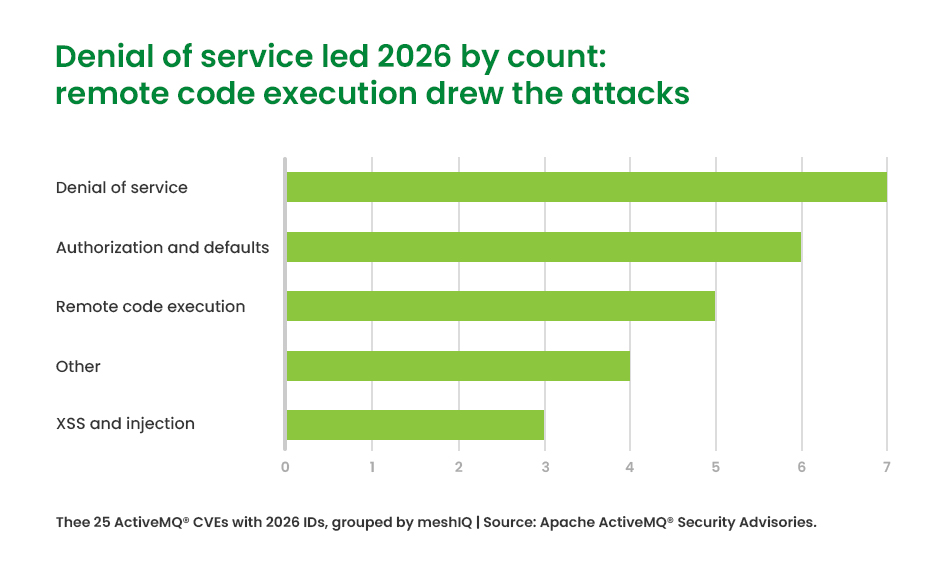
All five remote code execution flaws in 2026 ran through the broker’s management interfaces, and four of them used the same addNetworkConnector path or a variation of it. Add CVE-2026-49157, which let non-admin web users run admin operations, and Jolokia accounts for six of the year’s 25 CVEs. Counting from 2023, eight Apache ActiveMQ® CVEs run through Jolokia.
We traced all eight, why each patch missed the next attack, and how to lock down the whole surface in The Jolokia Problem. Read the full analysis →
2. Protocol parsers were the most common target
Seven of the 25 were denial-of-service flaws, mostly memory exhaustion in the code that reads OpenWire, STOMP, AMQP, and TLS traffic. Several need no login at all: an attacker only has to reach the port. Every protocol connector you leave enabled adds to this surface, which is why 5.19.7 and 6.2.6 now enable only OpenWire by default.
Mutual TLS stops unauthenticated clients before they can send a single frame. We’ll cover CVE-2025-27533 and why mutual TLS matters for these flaws in an upcoming post.
3. Defaults were the vulnerability
Six CVEs were about who could do what: non-admin web users with admin access by default (CVE-2026-49877, CVE-2026-49157), authorization gaps around temporary and composite destinations (CVE-2026-54475, CVE-2026-61487), and incomplete checks when removing destinations or durable subscriptions (CVE-2026-46605, CVE-2026-74761). Several of these weren’t coding errors so much as permissive defaults that nobody had revisited.
4. Fixes needed fixing
- Bypasses. CVE-2026-40466, CVE-2026-45505 and CVE-2026-42588 reached the same code execution as CVE-2026-34197 after its fix.
- A fix missed on one line. CVE-2026-40046 exists because the fix for CVE-2025-66168 (MQTT) was applied to 5.19.x but not to 6.x.
- A fix that broke something. CVE-2026-50750, a pre-authentication denial-of-service flaw, was introduced by the fix for CVE-2026-49270.
The lesson for operators: a single upgrade doesn’t close a family of flaws. Track each family until its last advisory, and expect follow-ups after any high-profile fix.
5. Researchers, and their tools, multiplied
One researcher, Leon Johnson, is credited on five of the 25. Teams credited as “pyn3rd, uname, 4ra1n” and “tonghuaroot” found two each. AI-assisted research appeared too: Horizon3.ai’s researcher reported finding CVE-2026-34197 with AI-assisted code review, and Apache credits CVE-2026-61487 to “Claude and Ada Logics”. Faster tooling is a reasonable explanation for part of the jump in volume. It’s also a reason not to expect 2027 to be quieter.
The biggest change wasn’t a CVE: secure defaults
Released on 31 May, 5.19.7 and 6.2.6 changed what a fresh Apache ActiveMQ® installation looks like. Apache’s release notes describe it as hardening the default configuration of the broker, the web console, and Jolokia. The changes include:
- Only the OpenWire connector enabled; AMQP, STOMP, MQTT and WebSocket commented out
- The web console limited to loopback addresses
- Jolokia limited to POST requests, with a deny list for broker-management operations, credential attributes, and the MBeans used in past attacks
- The deprecated message REST servlet disabled
- The VM transport is no longer able to load broker configuration from XBean URLs by default
- java.lang removed from the default list of trusted packages for object messages
- Security headers added to the web server, and commented templates for authentication, authorization, and auditing
Two caveats matter. First, the default admin:admin console login is unchanged; the new files only remind you to change it. Second, these defaults live in configuration files under conf/. A broker upgraded in place usually keeps its old files, and with them the old defaults. If you upgraded to 5.19.7 or later and didn’t compare your configuration with the shipped files, you probably don’t have most of these protections.
Our Apache ActiveMQ® Security Hardening Guide walks through each layer, from TLS to Jolokia lockdown, with a 17-item checklist. Read the full hardening guide →
Don’t forget the clients
Two of the most severe-sounding recent Apache ActiveMQ® CVEs weren’t in the broker at all. CVE-2025-54539 and CVE-2025-29953 let a malicious broker run code in .NET applications using the Apache.NMS clients, and both carry a 9.8 CVSS score from CISA. Patching brokers does nothing for them. We covered how to find affected .NET applications and move off binary serialization in Hidden Attack Surface: RCE in Apache ActiveMQ® .NET Clients. Read the full breakdown →
Java clients count too: Apache’s fix for CVE-2023-46604 told users to upgrade activemq-client in their applications, not only their brokers.
Which versions matter now
| Line | Latest release | Status | Java | What to do |
| 6.4.x | 6.4.0 (27 Oct 2026) | Active | 17 to 25 | New line; adds OAuth2 JWT login and SSL for JMX |
| 6.3.x | 6.3.3 (27 Oct 2026) | Active | 17 to 25 | The established 6.x line |
| 5.19.x | 5.19.12 (27 Oct 2026) | Active | 11 to 22 | Supported; no end-of-life date announced |
| 6.2.x | 6.2.10 (26 Sep 2026) | End-of-life | 17 to 22 | Move to 6.3.x or 6.4.x |
| 6.1.x, 6.0.x, 5.18.x and older | n/a | End-of-life | n/a | Upgrade now |
Source: Apache ActiveMQ® downloads.
5.19.11 and 6.3.2 were the first releases to fix all 25 of 2026’s advisories. Run them or anything later on a supported line. The 6.4.0 release notes also mention further hardening of Jolokia, the web console and LDAP, without listing CVEs.
We’ll cover how to sequence upgrades across versions safely in our upcoming Upgrade & Patching Strategy guide, and the wider question of Apache ActiveMQ®’s lifecycle in Apache ActiveMQ® EOL: What Enterprises Need to Know.
What 2026 signals for 2027 planning
- Plan for monthly patching. Apache shipped an Apache ActiveMQ® release every month from February to October, most of them carrying security fixes. A quarterly or annual patch window for Apache ActiveMQ® now leaves brokers exposed for months.
- Budget for configuration, not just binaries. The most effective 2026 fixes shipped as configuration files. Every upgrade needs a step where someone compares activemq.xml, jetty.xml, and jolokia-access.xml with the shipped versions.
- Decide your 5.19.x exit. 5.19.x is active and has no announced end-of-life date, but 6.2.x reached end-of-life two months after 6.3.0 arrived, and new features land in 6.x first. Moving to 6.3.x or 6.4.x needs Java 17. Planning that now is cheaper than doing it under a deadline.
- Expect more findings, faster. One researcher found five flaws; AI-assisted review found at least two more. Budget security response time for Apache ActiveMQ® the way you would for any internet-facing platform.
- Inventory the clients. Broker patching programs miss the .NET and Java applications that connect to brokers. 2027’s inventory should list every client library and version, not just every broker.
2027 Apache ActiveMQ® security checklist
- Every broker on a supported line: 5.19.x, 6.3.x or 6.4.x, at 5.19.11 or 6.3.2 or later.
- Configuration reconciled with the files shipped in your release.
- Jolokia restricted to admins and management networks, or removed.
- Unused protocol connectors disabled; mutual TLS where clients can support it.
- admin:admin and other default credentials gone.
- Every client library inventoried and upgraded, including NMS for .NET.
- A monthly Apache ActiveMQ® patch window, with an owner.
- A Java 17 plan for any broker still on 5.19.x.
Planning your 2027 Apache ActiveMQ® roadmap?
We’ll also look at an older risk that still turns up in inherited configurations, LDAP authentication with anonymous binds, in an upcoming post.
Talk to Apache ActiveMQ® Support →
See also: Apache ActiveMQ® CVE Guide: Complete Vulnerability Reference, part of our Apache ActiveMQ® CVE series.
Frequently asked questions
Apache published 25 Apache ActiveMQ® security advisories with 2026 CVE IDs as of late October 2026. Counting by NVD publication date, 26 Apache ActiveMQ® CVEs were published in 2026, because CVE-2025-66168 was published in March 2026. That is more than in 2018 to 2025 combined.
CVE-2026-34197, a remote code execution flaw reached through the Jolokia management API. CISA added it to its Known Exploited Vulnerabilities catalog on 16 April 2026. No other 2026 Apache ActiveMQ® CVE had a public exploitation report as of late October 2026.
As of 29 October 2026, the latest releases are 6.4.0, 6.3.3 and 5.19.12, all released on 27 October 2026. 5.19.11 and 6.3.2 were the first releases to fix all 25 of 2026’s advisories.
Yes. Apache marks the 6.2.x line as end-of-life; its final release was 6.2.10 on 26 September 2026. The 6.1.x, 6.0.x and 5.18.x lines are also end-of-life. Supported lines are 5.19.x, 6.3.x and 6.4.x.
Yes, if it’s maintained. Apache fixed every 2026 advisory and hardened the default configuration. The risk is in brokers left on end-of-life versions, with old configuration files, default credentials or management interfaces reachable from the network.
2026 showed that Apache ActiveMQ® security now moves at the pace of a monthly release train. meshIQ’s Apache ActiveMQ® engineers keep your brokers and clients current, reconcile every upgrade with the new defaults, and watch each advisory as it lands, so your team isn’t rebuilding its patch plan every month.