

Over the past year, AI has moved from answering questions and generating content to taking action. Agents now update records, issue refunds, call APIs, start workflows and touch sensitive data. Once an AI system can act, the risk changes. A bad answer from a model is easy to ignore. A bad action from an agent may already be in motion before anyone notices.
That is the shift from AI accuracy to AI authority. The question is no longer only whether an agent’s output is correct. It is whether the agent should be allowed to do what it is about to do, under these conditions, for this user.
There are two easy answers, and both fail. Block every risky action and you get an agent that can observe and recommend but not accomplish much. Grant unrestricted autonomy and you may not know you’ve gone too far until something happens that can’t be undone. The real work is deciding how much autonomy is right for each action, and when a human needs to come back into the loop.
This post lays out a practical framework for risk-tiered AI agent governance: how to score agent actions, design approvals people actually use, start from zero trust, and show auditors that your agents are under control.
Why “allow or block” breaks down in production
Most teams start with a simple rule: let the agent read anything, but block anything risky. It feels safe, but it is a black-and-white answer to a gray problem. Restrict everything and you lose the autonomous decision-making that makes agentic workflows worth building. Allow everything and the blast radius becomes too big to control.
The opposite failure is just as common. Many agents ship with a single purpose, such as looking up a travel itinerary or taking a restaurant order, but run on a general-purpose LLM that can do almost anything. With no guardrails, the agent keeps trying to solve whatever it is asked, including questions it was never meant to answer. The tools agents connect to also keep gaining capabilities. An integration that could only read email last quarter may be able to send and delete it now, and new frontier models arrive every few months.
The result: agents that can do far more than they were built to do. The answer is not allow or deny. It sits in the middle, and it depends on the action.
How to score the risk of an agent action
Sending an internal notification is very different from moving money out of the company. To tell these apart consistently, rate every action an agent can take on four factors:
| Factor | The question it answers | Low risk | High risk |
| Reversibility | Can we undo it? | Draft a reply | Delete records, send a payment |
| Financial impact | What does it cost if wrong? | $50 refund | $50,000 write-off |
| Data sensitivity | What data does it touch? | Public product info | PII, health or account data |
| Who it affects | Who feels the result? | One internal user | Customers, partners, the public |
The combined score maps to one of four outcomes:
- Allow: the action runs on its own.
- Confirm: the user confirms before it runs.
- Escalate: a named approver or team must sign off.
- Deny: the action is outside what this agent may ever do.
Take an insurance claims agent handling write-offs. Small write-offs can be approved automatically, because a person reviewing each one adds cost without reducing much risk. Above a threshold, a claims adjuster approves. Above a higher threshold, a manager or director signs off. The same tool, approve write-off, gets a different decision depending on the value in the call and the role of the user behind it.
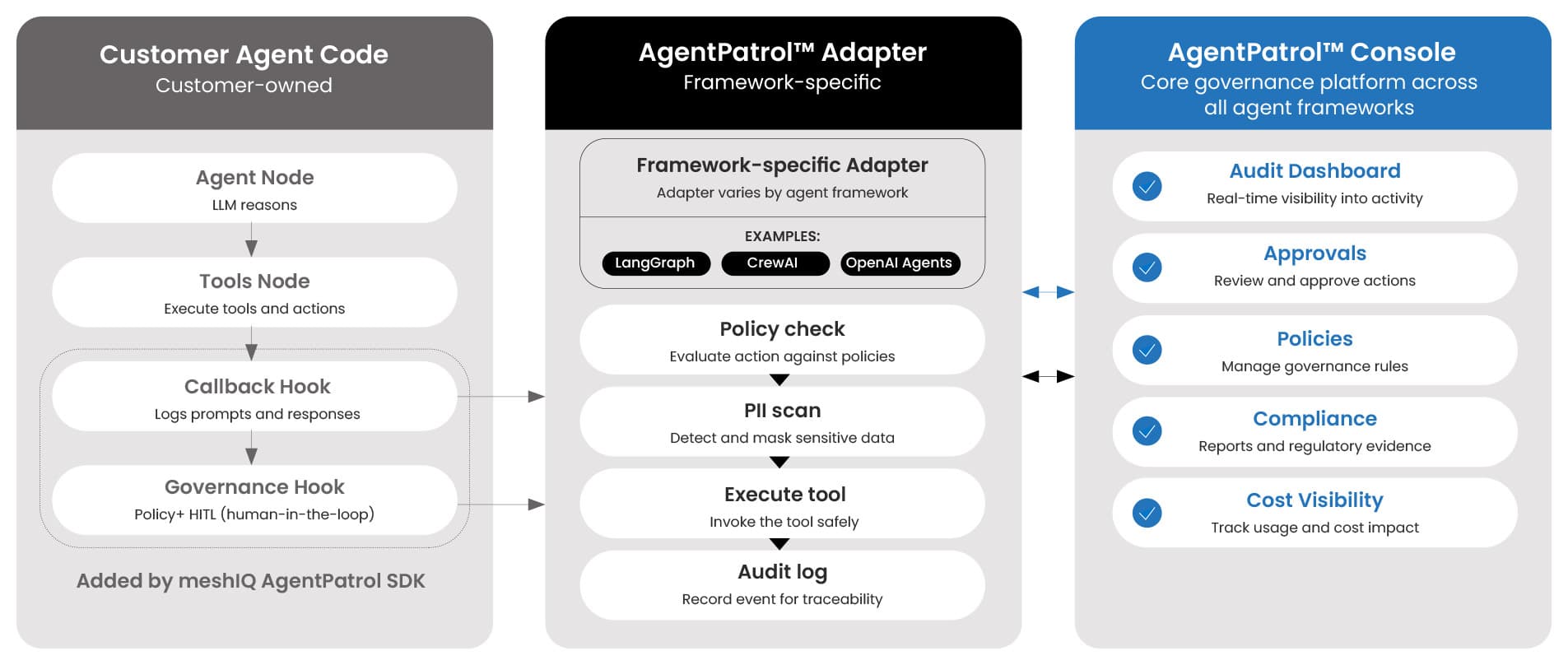
That is the key difference from traditional workflow automation. Older systems hard-coded every rule into a predefined path. Agents choose their own path at runtime, so the rules need to live at the point where the decision is made, as a policy check that runs before each action executes. We call this in-flow governance.
Who should own the boundaries?
Someone still has to decide where the thresholds sit. In the past, software came from a core engineering team you could draw a box around: trained, certified and following policy. Today, agents are built by data scientists, business technologists and individual developers across the company. As the circle widens, a shared understanding of risk gets thinner.
That is why ownership of agent risk should be centralized, either as a governance or security team that every agent flows through, or as a center of excellence that sets the rules. That team defines policy once, sees which tools each agent can call, and updates the rules as tools gain new capabilities. Developers then build agents without coding approval logic into each one.
Designing human approvals people actually use
Once an action crosses a threshold, governance moves from automated policy to human judgment. That sounds safe until someone has 200 requests in their queue. When everything is escalated, approvals become noise and people start rubber-stamping.
The fix starts with a mindset: a well-built agent should need fewer human approvals than the manual process it replaces, not more. Consider a request for a new laptop power adapter. In a traditional service desk, a person approves every request. A governed agent can approve an employee’s first adapter request in three years automatically, and escalate the tenth request in six months, because the pattern itself signals risk. Human attention goes where it adds value.
Timing matters too. An agent may be waiting inside a workflow that expects a decision in seconds, while the approver is out until tomorrow afternoon. These are not new problems. Business process management (BPM) tools solved them years ago with timeouts, reassignment when an approver is on leave, and escalation paths. Agentic systems should borrow those patterns rather than reinvent them:
- Set a time limit for each approval tier.
- Reassign or escalate automatically when an approver doesn’t respond.
- Define what the agent does while it waits: pause and hold its state, or fall back to a safe default.
- Resume with full context once a decision is made.
Start at zero trust, then expand autonomy with evidence
Teams don’t need to grant maximum autonomy on day one. A zero trust posture for agents means starting with narrow permissions, watching what the agent actually does, and widening its authority only where the evidence supports it.
The good news is that you rarely start from scratch. Most processes an agent takes over already have a policy behind them. A corporate policy probably says which accessories a help desk agent can approve and which need a manager. That policy may live in a PDF or inside service desk software. The first step is translating those existing rules into agent policy, not leaving the agent to its own judgment.
Then keep watching. Governance is not set-and-forget. You need visibility down to the trace level: the user’s request, the call to the LLM, each tool call, and the policy decision on every step. That trace serves three purposes:
- Compliance and audit: proof of what happened and why.
- Improvement: evidence of where policies are too tight, too loose or missing.
- Cost control: if an agent costs more to run than the person who did the job before, you need to see it and fix it.
When an agent’s record shows it behaves as expected for a given action, you can move that action from confirm to allow. Autonomy becomes something earned, not assumed.
Mapping risk-tiered governance to NIST AI RMF and the EU AI Act
Regulated organizations in banking, insurance and healthcare also have to explain their approach to auditors, legal teams and regulators. A risk-tiered model maps cleanly to the frameworks they already know.
The NIST AI Risk Management Framework, a voluntary US framework, organizes AI risk work into four functions: Govern, Map, Measure and Manage. Central policy ownership supports Govern. Scoring actions on four risk factors supports Map and Measure. Allow, confirm, escalate and deny decisions are how you Manage risk in operation.
Article 14 of the EU AI Act requires high-risk AI systems to support effective human oversight. Overseers must be able to understand the system’s limits, stay alert to over-reliance on its output, override or reverse its decisions, and halt it through a “stop” button or similar procedure. Article 14 also says oversight should match the system’s risks, level of autonomy and context of use, which is the idea behind risk tiers. Escalation paths, kill switches and approval records give you concrete evidence for each requirement.
In practice, auditors look for oversight at three levels:
- Portfolio: overall risk scores, human oversight rates and policy enforcement rates across all agents.
- Agent: cost, human-in-the-loop frequency and policy outcomes for each agent.
- Action: a unified trace that shows each step the agent took, the governance decision applied, any human approval and the response, all in one record.
Metrics answer what happened. The unified trace answers how it happened, which is what auditors increasingly ask for. Governance moves from an internal engineering choice to something the organization can defend and demonstrate.
Three things to do this month
If you have agents going into production next quarter, start here:
- Test what your agent can actually do. Compare its intended purpose with its real capabilities. Ask it things it was never meant to handle and watch what it attempts. Without guardrails, most agents will try far more than you expect.
- Turn existing policies into agent policy. Pull the approval rules you already have and score each agent action on reversibility, financial impact, data sensitivity and who it affects. Map each to allow, confirm, escalate or deny.
- Instrument before you scale. Capture a unified trace of agent actions and governance decisions from day one, so you can prove control and expand autonomy based on evidence.
How AgentPatrol™ helps
AgentPatrol™ is meshIQ’s in-flow AI agent governance SDK. It runs inside the agent’s execution path and checks each action against policy before it runs, resolving it to allow, confirm, escalate or deny based on the values in the call and the user’s role. Agents can pause for human approval and resume with full context. Sensitive data is masked before it reaches the model, and every action and decision is captured in one unified trace. It works with LangGraph, OpenAI Agents SDK, CrewAI, AWS Strands and Google ADK, so teams can connect one or two agents and see the results quickly.
The goal of AI agent governance is not to eliminate autonomy. It is to make autonomy proportional to risk, and to adjust it over time as the evidence comes in.
Frequently Asked Questions
An approach that scores each agent action by risk and decides whether to allow it, ask the user to confirm, escalate it to an approver, or deny it.
Rate it on reversibility, financial impact, data sensitivity and who it affects, then map the combined score to an outcome.
Escalate only the actions that truly need judgment, use behavior patterns to spot unusual requests, and set timeouts and reassignment rules for approvers.
Start agents with narrow permissions and expand their autonomy only when audit evidence shows they behave as expected.
Article 14 requires human oversight proportionate to risk, including the ability to override or stop a system. Risk tiers, escalation paths, kill switches and unified traces provide that evidence.
Sources
- NIST, AI Risk Management Framework resources
- European Commission AI Act Service Desk, Article 14: Human oversight
- meshIQ webinar, How Much Autonomy Should Your AI Agents Have? A Framework for Risk-Tiered Agent Governance