

The Operating Models of Today
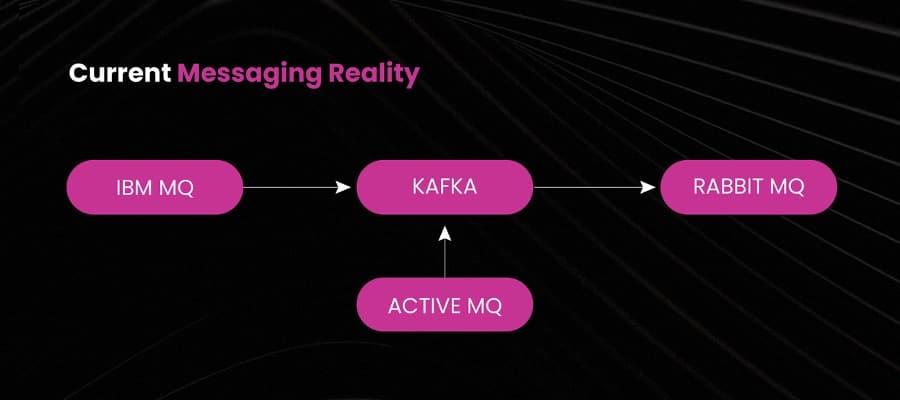
Enterprises rarely rely on a single broker. Most operate in a combination of models that reflect both legacy investments and new digital demands:
- IBM MQ remains the transactional backbone in many banks, retailers, and healthcare providers, where reliability and compliance are paramount.
- Apache Kafka® is increasingly adopted for high-volume, real-time streaming and event-driven architectures.
- Apache ActiveMQ® persists in Java-centric environments as a lightweight, JMS-compatible option for application integration.
- RabbitMQ thrives in microservices and cloud-native ecosystems, valued for its simplicity and protocol flexibility.
The result is a hybrid mix: MQ at the core, Apache Kafka® powering streams, RabbitMQ bridging microservices, and Apache ActiveMQ® filling JMS workloads. While pragmatic, this mix multiplies cost, complexity, and operational silos.
The Consequences — and Their Business Impact
The impact of this hybrid reality is not abstract. It is visible in IT budgets, financial statements, and stalled transformation projects.
Direct Cost
The financial burden varies by industry but is universal in effect. In banking, IBM MQ licensing tied to mainframes and HA clusters drives six- or seven-figure annual costs.
In telecoms, Apache Kafka®’s infrastructure footprint balloons as event retention requirements grow.
In healthcare and the public sector, even “free” brokers like RabbitMQ or Apache ActiveMQ® add cost through integration projects, cloud service subscriptions, and duplicated infrastructure.
The outcome is the same: a rising total cost of ownership that diverts funds from innovation.
Labour Drain
Scarce expertise is consumed by low-value operational work.
In financial services, MQ administrators manage queue managers to ensure payments settle on time. In media and entertainment, Apache Kafka® engineers rebalance partitions and scale clusters under streaming load.
In retail and logistics, teams reconcile mismatched orders and invoices across RabbitMQ queues.
In manufacturing, developers tune RabbitMQ exchanges or Apache ActiveMQ® brokers just to keep integrations running.
Developers and ops teams alike are slowed by the need to raise tickets for even basic changes. The cost of labour per transaction rises across the board.
Financial Leakage
Messaging failures translate directly into lost profit. In consumer goods and retail, inaccurate ASNs or invoice mismatches trigger chargebacks.
In banking and payments, missed cut-offs or duplicate wires lead to reversals and fines. In insurance, delayed claims settlements drag on margins.
In manufacturing and logistics, message loss or backlog in RabbitMQ or Apache ActiveMQ® clusters causes production stoppages and delivery penalties.
Across industries, these cracks add up to 1–5% of EBITDA leakage every year, silently draining profit.
Risk and Compliance Pressure
Regulatory expectations are rising everywhere. Banks must evidence resilience under DORA and Basel III. Insurers face Solvency II scrutiny of claims processing.
Healthcare providers must ensure HIPAA-compliant data flows.
Manufacturers require supply chain traceability. Auditors no longer accept “best effort dashboards”, they demand audit-ready proof across MQ, Apache Kafka®, RabbitMQ, and Apache ActiveMQ®.
Producing this manually is costly and slow.
Stalled Digital Progress
Digital transformation gets delayed when operations dominate resources.
In e-commerce and retail, RabbitMQ backlogs or poorly tuned exchanges delay order confirmations and inventory updates, directly slowing down new customer-facing features like same-day delivery or personalized offers.
In telecoms, Apache Kafka® integration bottlenecks don’t just delay 5G service launches; they slow the rollout of network slicing and IoT monetization models that are core to growth.
In healthcare, HL7 messaging on IBM MQ often collides with API-driven patient engagement platforms, stalling initiatives such as real-time appointment scheduling or telehealth expansion.
In insurance, legacy Apache ActiveMQ® deployments used in claims processing struggle to integrate with modern SaaS platforms, delaying digital claims journeys that competitors are already offering.
The common outcome across industries is the same: new services reach customers later, experiences are delayed, and competitors that modernize faster seize market share.
The Future State Enterprises Aspire To
Forward-looking enterprises imagine a different state: leaner, modernized, and visible end-to-end.
In this model:
- Self-service allows developers to provision queues, trace flows, and troubleshoot independently — with policy guardrails in place. Release cycles shorten dramatically because teams no longer wait days for central approvals.
- Automation tunes performance dynamically, scales queues, and rebalances workloads without tickets or manual intervention. Scarce experts are freed from firefighting and can focus on building new digital services.
- Modernization projects run without disruption, as APIs and real-time events coexist with legacy EDI and batch until the transition is complete.
- Visibility provides a single lens across MQ, Apache Kafka®, RabbitMQ, and Apache ActiveMQ®, ensuring no blind spots and producing audit-ready evidence instantly.
The business impact is transformative:
- Chargebacks reduced by up to 40%.
- Reconciliation effort cut by 50–70%.
- Incidents resolved 70% faster.
- Release cycles accelerated, enabling faster delivery of customer-facing features.
- Financial closes shortened from weeks to days.
Profit is protected, compliance assured, and innovation accelerated.
Exploring the Viability of Migration
For over three decades, IBM MQ has been the backbone of mission-critical messaging. Its guarantees of exactly-once delivery, transactional integrity, and mainframe integration make it indispensable for certain flows.
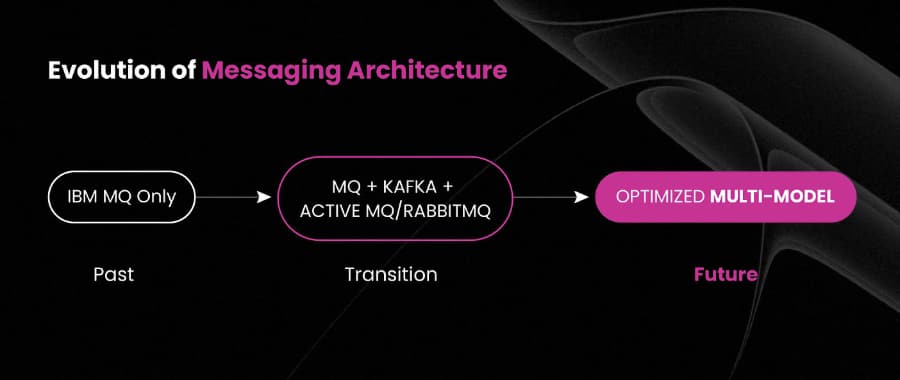
For many organizations, outright replacement of MQ is not just difficult; it may be impossible without unacceptable risk.
So the real question is not “How do we migrate from MQ?” but rather:
- Where is MQ still essential? Mission-critical settlements, regulatory reporting, and mainframe integrations may always need MQ.
- Where does MQ constrain agility? Modern customer experiences, real-time analytics, and API-driven services may demand Apache Kafka®’s scalability or Apache ActiveMQ®’s simplicity.
- Can new patterns coexist with the old? Hybrid architectures are often the most pragmatic answer.
- Can alternatives reduce costs in non-production? Many enterprises run multiple MQ instances across dev, test, pre-prod, and DR. Substituting Apache Kafka®, Apache ActiveMQ®, or RabbitMQ in these environments can reduce licensing costs while still enabling realistic testing.
This viability check shifts the conversation from “rip and replace” to “coexist, extend, and optimize.”
Apache Kafka®, RabbitMQ, and Apache ActiveMQ® don’t necessarily replace MQ in production; they extend the capability where MQ cannot keep up, and can also substitute in non-production to lower costs.
Migration Pathways: From IBM MQ to Apache Kafka® and Apache ActiveMQ®
When production workloads do evolve, the practical path is incremental migration, not replacement, but coexistence:
- Run in Parallel: IBM MQ continues to handle system-of-record transactions, while new Apache Kafka® topics or Apache ActiveMQ® destinations are introduced for modern workloads.
- Bridge the Ecosystem: Connectors and integration tools move data between MQ and Apache Kafka®/Apache ActiveMQ®. MeshIQ sits above this layer, assuring that flows across old and new systems remain consistent.
- Validate Integrity: MeshIQ provides end-to-end operational visibility, detecting failures or mismatches instantly, routing them to the right team, and generating audit-ready evidence.
- Phase the Cutover: Workloads are gradually transitioned, with MeshIQ maintaining visibility and reconciliation across both environments.
- Decommission with Confidence: Legacy MQ instances can be reduced once continuity is proven, knowing operational integrity has been preserved.
How MeshIQ Shapes the Answer
MeshIQ does not move the messages. Instead, it ensures that operations are lean, modernization is safe, and visibility drives business results:
- Lean Operations: Intelligent automation reallocates resources, scales queues, and tunes performance. Developers gain self-service with governance, so they can provision and trace flows without waiting for central teams. The result is faster delivery and lower labour costs.
- Modernization Without Disruption: MQ, Apache Kafka®, RabbitMQ, and Apache ActiveMQ® can run side by side, with MeshIQ maintaining reconciliation parity and governance. Enterprises gain confidence that transformation won’t erode reliability or compliance.
- Visibility That Protects EBITDA: End-to-end tracing and audit-ready evidence catch financial leakage before it hits the P&L and reduce audit preparation by up to 60%.
In this way, MeshIQ transforms modernization from a high-risk cutover into a controlled evolution, where operational efficiency improves from day one.
The Bottom Line
Choosing between MQ, Apache Kafka®, RabbitMQ, or Apache ActiveMQ® is not enough. The real differentiator is an assurance layer that spans them all.
MeshIQ provides that layer. It enables lean operations through self-service and automation, supports modernization without disruption, and ensures visibility that protects profit, compliance, and trust.
Modernization is not about replacing one broker with another. It is about transforming operations, modernizing platforms, and gaining visibility that protects the bottom line. That is the journey MeshIQ enables, across MQ, Apache Kafka®, RabbitMQ, and Apache ActiveMQ®, wherever you are starting from.